Recently there was a patient admitted who had been involved in an MVC, had some T and L spine tenderness and on CT recons was found to have a chance fracture of L1. So what does that mean, exactly?
Spinal fractures are obviously critically important diagnoses in trauma because of the importance of the spinal cord. In addition, many fracture patterns carry important implications for other injury patterns in polytrauma. Chance fractures are one such fracture pattern.
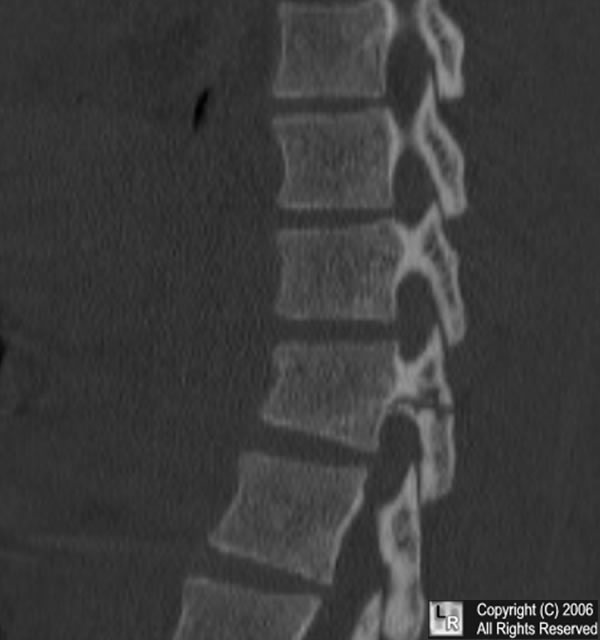
Chance fractures progress from posterior to anterior and involve the posterior, middle and anterior columns of the spine. They are most commonly found at T12-L2. You can see a representative example below:

The mechanism is flexion-distraction, which is most commonly encountered with a seat-belt injury pattern, and less commonly with falls from height with axial load. Seeing a “seatbelt sign” on the abdomen with associated back pain should raise concern for this injury. Importantly, ~50% of these fractures are associated with intra-abdominal injuries (estimates vary from 33-89%), so finding this injury should prompt thorough work-up for abdominal problems. Obviously a complete neurologic exam should be completed to evaluate for any deficits indicating spinal cord injury.
Patients with Chance fractures are treated with immobilization, as these injuries are considered unstable. Many of them require operative management, particularly if there is ligamentous injury or kyphosis. Children with this injury typically require surgery, and have an even higher incidence of intra-abdominal injury.
Pearls:
1. Be aware of this fracture pattern for all MVC victims with back pain
2. Be suspicious of “compression,” or “wedge” fractures in young people in MVCs: get the CT to look for chance fracture, which can be distinguished from the first 2 by the characteristic posterior column involvement.
3. If you find a chance fracture, evaluate for intra-abdominal injury, as they occur ~50% of the time
Sources:
“Chance Fractures of the Spine.” In: Wheeless’ Textbook of Orthopaedics, online at http://www.wheelessonline.com/ortho/chance_fracture_of_the_spine .
“Chapter 75: Spine Trauma and Spinal Cord Injuries.” In: Adams, et al, ed. Emergency Medicine. 2nd edition, Elsevier, 2012.
from Dr. Nick Hartman

No comments:
Post a Comment